For decades we assumed that the world of racing and the world of big Harley-Davidson touring bikes belonged to two completely different universes.
On one side, race bikes: light, radical, razor-sharp, built to shave tenths off the clock. On the other, Harley-Davidson Grand American Touring machines: big, heavy, powerful, built to swallow miles.
But that line has just started to blur.
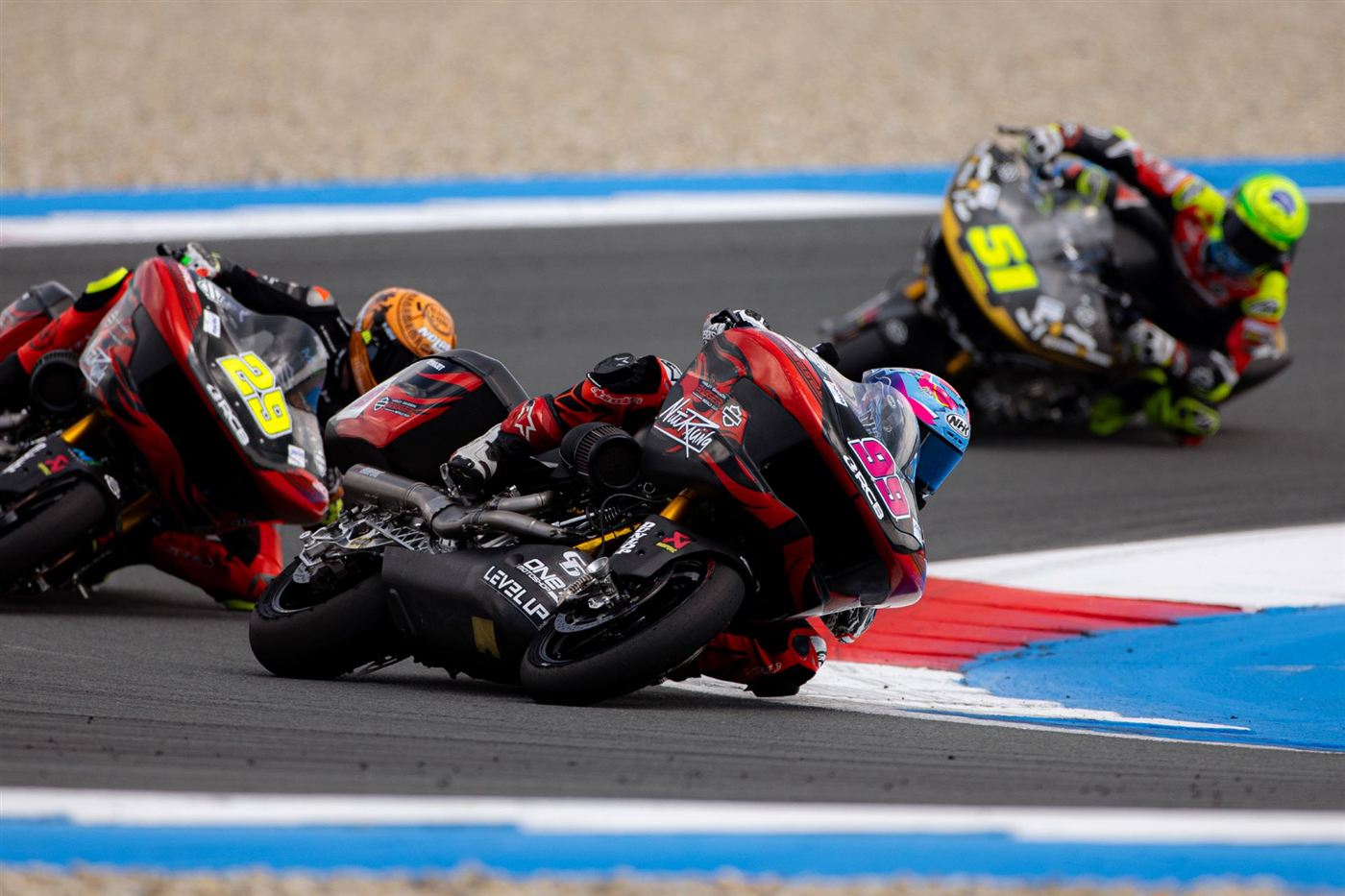
The FIM Harley-Davidson Bagger World Cup, developed alongside MotoGP and Dorna, has taken Milwaukee's big baggers to some of the most important circuits in the world. This isn't an exhibition or a marketing stunt — it's a genuine international championship with six rounds, twelve races, run inside MotoGP race weekends. The bikes, built on the Grand American Touring platform and developed by Harley-Davidson Factory Racing, put out more than 200 hp and can hit speeds close to 300 km/h (186 mph). (Want to know where the standings sit right now? Check the current results and full season calendar here.)
And that raises the real question:
What could all of this, happening on track today, bring to the Harley-Davidsons we'll see at the dealership tomorrow?
Because motorcycling history has proven it time and again: racing isn't just about winning. It's about learning.
When a 280 kg Bike Hits the Track
A race-prepped Road Glide doesn't behave much like the traditional image most people have of a big American tourer.
The Bagger World Cup has forced Harley-Davidson and the teams involved to tackle an extraordinary challenge: getting a large, heavy motorcycle to brake late, change direction fast, hold its line at high speed and take race-pace punishment lap after lap.
The championship bikes start from the Grand American Touring platform, but they're deeply transformed — race-tuned engines, weight reduction, suspension, brakes, electronics and serious aero work.
In other words, Harley-Davidson is taking its bagger concept into territory that would have seemed almost impossible just a few years ago.
And that's exactly where this championship gets interesting. This isn't about thinking the next Road Glide to hit a dealership floor will be a street-legal race bike. It's about understanding that, to make these huge machines work on a circuit, Harley-Davidson is racking up a massive amount of experience in areas that matter — a lot — on a road bike too.
Racing as a Laboratory: 5 Areas Evolving Right Now
Racing speeds everything up.
On the road, an improvement can take years to prove itself. On a circuit, every session delivers instant feedback. Repeated braking, extreme temperatures, acceleration, vibration, direction changes and thousands of miles ridden flat out. Nothing stays hidden.
And when we're talking about bikes putting out over 200 hp and weighing around 280 kg at speeds up to 300 km/h, the demands go up even further. That forces engineers to work on five key areas that could, sooner or later, filter down to production motorcycles.
1. Brakes: Stopping a Bagger Is Also Technology
Braking might be one of the areas where we'll most easily see knowledge transfer.
Stopping a heavy motorcycle at circuit speeds takes a lot more than bolting on big discs. You have to study heat resistance, lever feel, chassis stability, and how the whole system holds up under enormous load.
Racing lets engineers find out what works and what needs improving. And while a stock Road Glide will never have to brake from 300 km/h like a race bike does, the knowledge gained can help make future street Harley-Davidsons safer, tougher, and better-feeling under braking.
2. Suspension: The Real Secret Behind a Bike That Looks Impossible to Lean
Watching a bagger tip into a corner at that size is spectacular. But making it happen takes extremely precise suspension and geometry work.
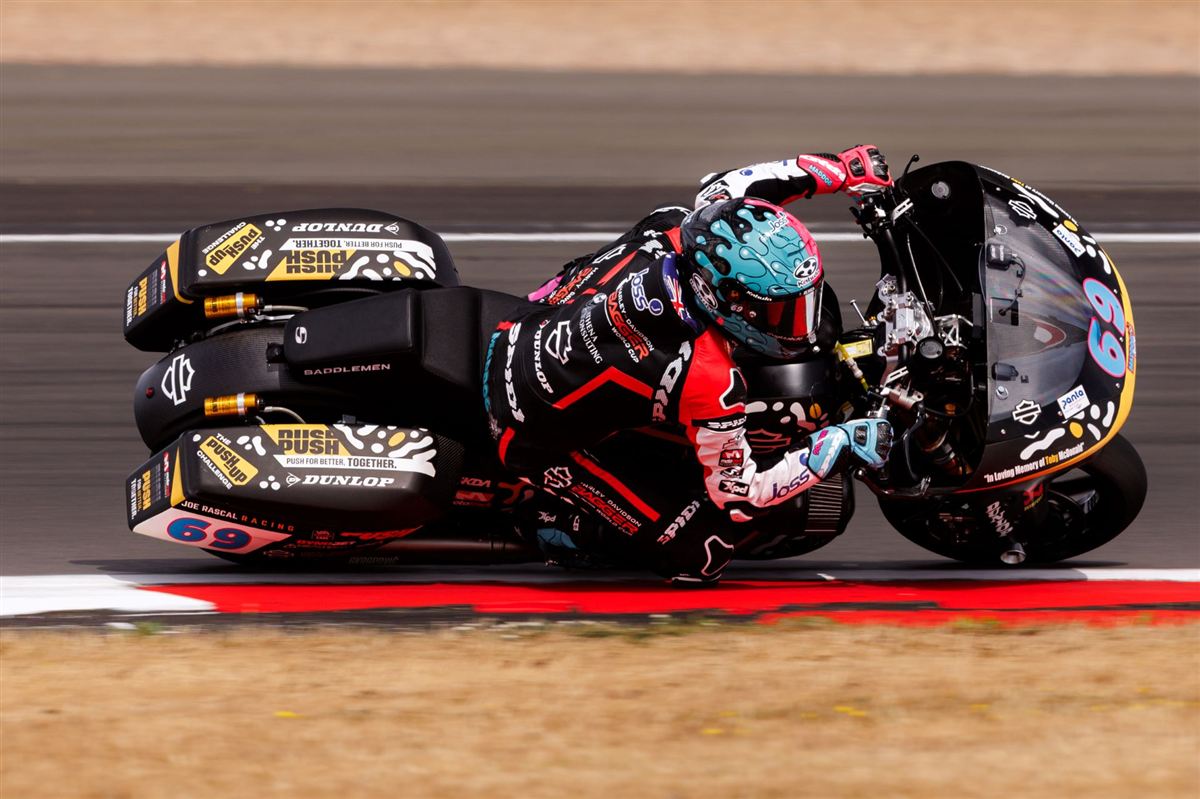
A touring bike has to stay comfortable for hundreds of miles. A race bike, on the other hand, needs feedback, support and precision. Harley-Davidson's real opportunity lies in finding solutions that bring both worlds closer together.
It wouldn't be surprising if some of the experience gained in competition eventually feeds into more sophisticated production suspension setups — more adjustability and, above all, sharper response, without losing the touring soul of a big Harley.
The question isn't whether a bagger can race anymore. The Bagger World Cup has already proven it can. The next question is: how much of that agility can make it onto the street?
3. Aerodynamics: More Than Just a Big Fairing
Harley-Davidson baggers have always had a very distinct visual identity. The Road Glide, in particular, is recognizable from miles away thanks to its huge front fairing.
But once a bike gets close to 300 km/h, aerodynamics stops being about looks. Every bit of airflow matters. Stability, front-end pressure, rider protection, and even how air affects the bike's overall behavior all become critical.
Racing lets engineers experiment and measure. And while we probably won't see MotoGP-style winglets on an Electra Glide anytime soon, it's entirely reasonable to think the aero knowledge gained here could eventually shape future fairings, windshields, and solutions aimed at better high-speed stability and comfort.
The road may not look much like Mugello. But a Harley-Davidson that handles better at 120 km/h can absolutely benefit from lessons learned at 280.
4. The Engine: More Power, But Also More Control
The Bagger World Cup runs Harley-Davidson Road Glide race bikes built specifically to compete, tuned to put out more than 200 hp. The technical foundation still carries the unmistakable character of the big American V-Twin, pushed to a performance level far beyond any conventional tourer.
But the most interesting transfer probably isn't just raw power. It's control over that power.
How to deliver torque. How to manage throttle response. How to improve cooling. How to keep performance consistent. How to make a powerful motorcycle stay manageable.
Racing pushes all of these systems to their limit. And that experience can end up translating into more refined production engines, with more usable power delivery and electronics that are ever more integrated into the riding experience.
Because the future of high-performance Harley-Davidsons probably won't be just about more horsepower. It'll be about knowing what to do with it.
5. Electronics: The Future Is Coming to Baggers Too
Harley-Davidson has built much of its identity around ideas like the V-Twin engine, the sound, the torque, and a very direct connection between rider and machine.
But modern racing demands electronics. And the Bagger World Cup is also the perfect stage for figuring out how to apply that technology to a motorcycle with such a distinct personality.
Traction control, power management, brake systems and other electronic aids let engineers work out how to make an extremely powerful bike faster — and also more controllable.
Technology will have to serve the riding experience, not replace it. And that might be one of the most interesting outcomes of the Bagger World Cup: the possibility that future Harley-Davidsons become more technologically advanced without losing their character.
From King of the Baggers to the World Stage
None of this came out of nowhere. The Bagger World Cup is the international evolution of a phenomenon that started changing how people saw big American motorcycles: King of the Baggers.
Those first images of huge touring bikes racing on circuit sparked surprise. Then curiosity. And finally, something far more important: real interest.
Harley-Davidson realized there was an entirely new space between custom culture, touring, and performance.
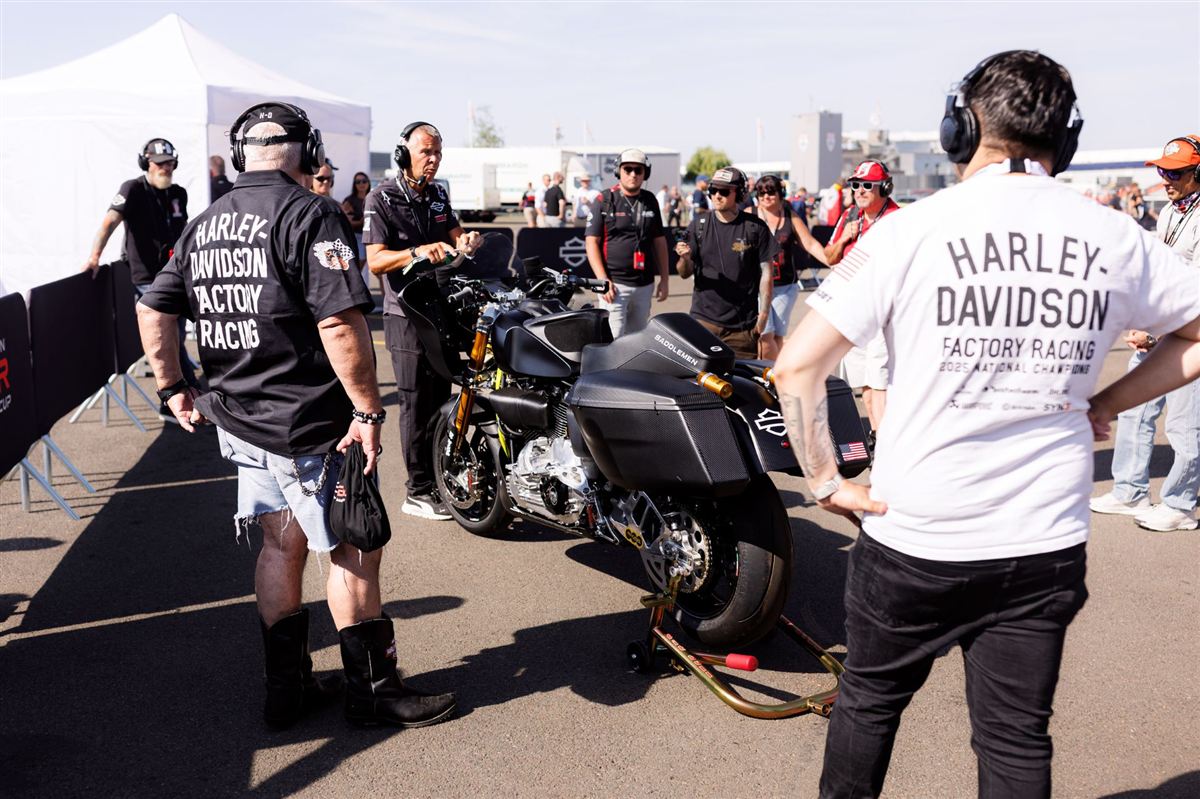
The Bagger World Cup now takes that idea global, sharing race weekends with MotoGP at circuits like Circuit of the Americas, Mugello, Assen, Silverstone, MotorLand Aragón and Red Bull Ring.
And that international exposure could have another important consequence. For years, for many European riders, Harley-Davidson meant one very specific way of understanding a motorcycle: cruising, the open road, travel and American culture.
Now it's also building a new image.
Harley-Davidson can race. And not just race — it can compete at the highest level on some of the most prestigious circuits on the planet.
The Influence Will Be Visual Too
Racing doesn't just change technology. It changes what people want.
Every time a Road Glide leans into a corner at an angle that seems impossible, brakes hard at the end of a straight, or battles wheel-to-wheel with another bagger, it's building a new image of the motorcycle. And that image can reach the dealership even before many of the technical innovations do.
Sportier versions. Higher-performance components. Race-inspired colors. Dedicated suspension setups. Stronger brakes. Accessories born straight out of racing aesthetics.
Racing has always worked this way. First we see a bike that makes us dream on track. Then we want our road bike to carry, even in some small way, a piece of that DNA.
And Harley-Davidson has a huge opportunity here, because baggers are probably one of the platforms with the most potential to build a new family of high-performance motorcycles without abandoning the brand's historic identity.
We Won't See Race Bikes at the Dealership… But We'll See Their DNA
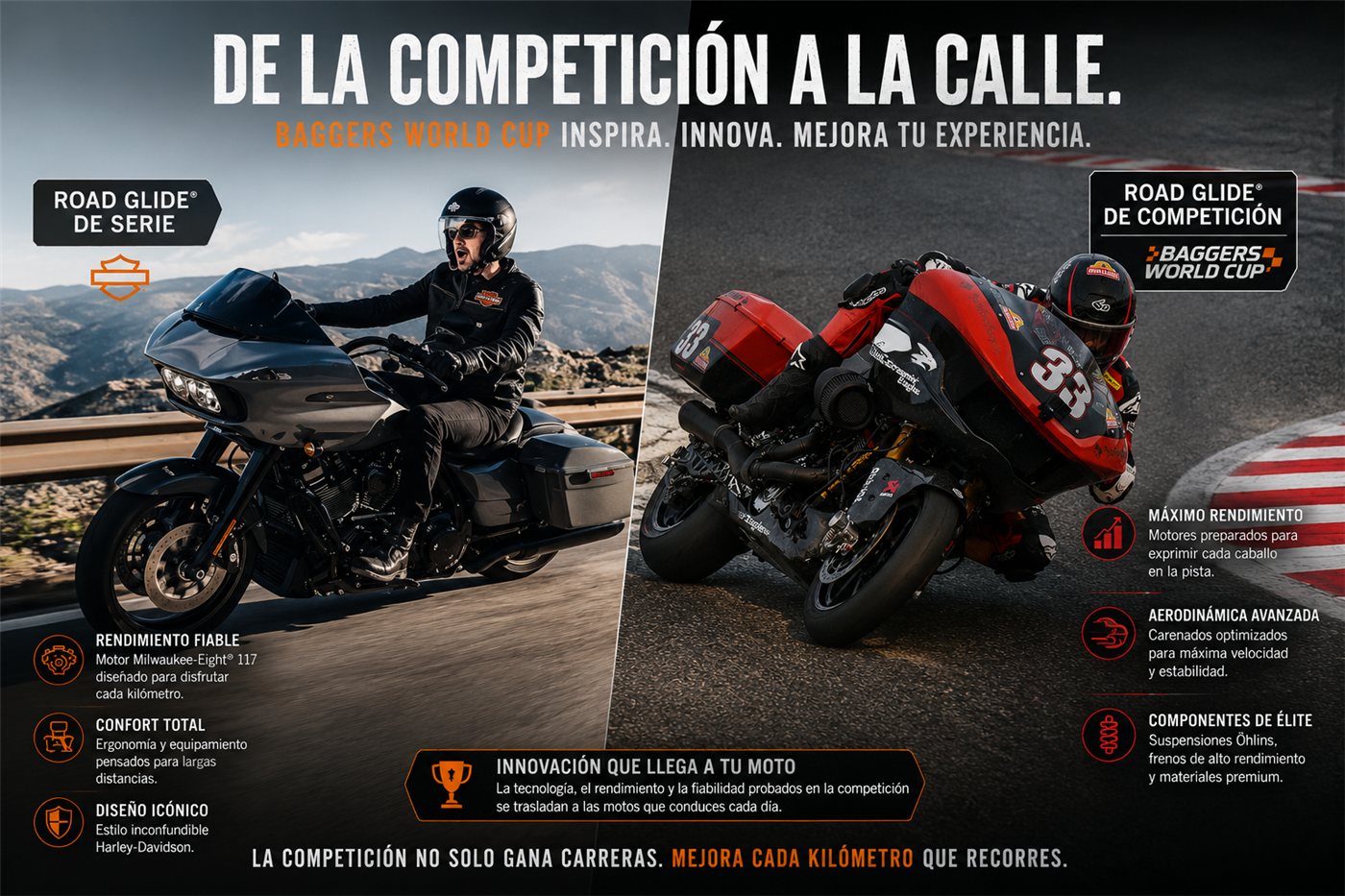
It's worth not confusing racing with production.
A Harley-Davidson Bagger World Cup machine is built to race. Its job is to win. A production Road Glide or Street Glide has to run for years, carry luggage, cover thousands of miles, and deliver comfort and reliability.
They're different worlds. But there's a bridge between them: experience.
Every race generates data. Every crash reveals a weakness. Every win confirms a solution. Every circuit poses a different problem. And all of that learning can end up shaping the brand's future.
We probably won't be able to point at one specific part and say "this came straight from the Bagger World Cup." Technology transfer rarely works that simply. But we will be able to see the evolution.
Harley-Davidson is putting its bagger concept through the most extreme demands imaginable. It's pushing its engineers, riders and teams to find new ways to make a big American V-Twin brake, accelerate, turn and hold pace. And that will inevitably have consequences.
The Track as a Showcase for the Future
The FIM Harley-Davidson Bagger World Cup could become something far more significant than just a new championship. It could be a turning point.
For years, racing and big touring bikes seemed to travel down completely different roads. Now both have met on the same circuit.
Harley-Davidson is proving that a bagger can be huge, heavy, powerful — and, at the same time, extraordinarily fast. And while riders battle for tenths of a second at Mugello, Silverstone or MotorLand Aragón, it's entirely possible that development teams are already working on another race: the race to decide what tomorrow's Harley-Davidsons will look like.
Maybe a few years from now, walking into a dealership and finding a new generation of baggers — sharper, more powerful, more stable, more advanced, with an even more aggressive look — we'll be able to look back and remember those huge Road Glides leaned over on a MotoGP circuit.
Because some of the motorcycles we'll ride on the road tomorrow might be under construction right now, lap after lap, at the Harley-Davidson Bagger World Cup.
Want to see the Road Glide and the rest of the touring range up close? Check out the full Harley-Davidson range available at Espacio HD Barcelona.