For years, talking about an adventure bike meant talking about a machine ready for everything: roads, tracks, trails, long journeys and, to a greater or lesser extent, difficult terrain.
But perhaps that idea is changing.
The reality is that many riders use their big adventure bikes almost exclusively on tarmac. They ride on motorways, cross cities, enjoy secondary roads, climb mountain passes and look for bends. The countryside may be part of the adventure, but for many it is not the usual setting.
And that is precisely where the Harley-Davidson Pan America 1250 ST makes sense.
The ST is not simply a Pan America with a more tarmac-oriented approach. It is a statement of intent: Harley-Davidson has taken the Pan America platform and pushed it towards a clearly sporty, road-focused concept, designed to enjoy the road.
A Pan America designed around tarmac
The fundamental difference compared with the Pan America Special lies in the philosophy.
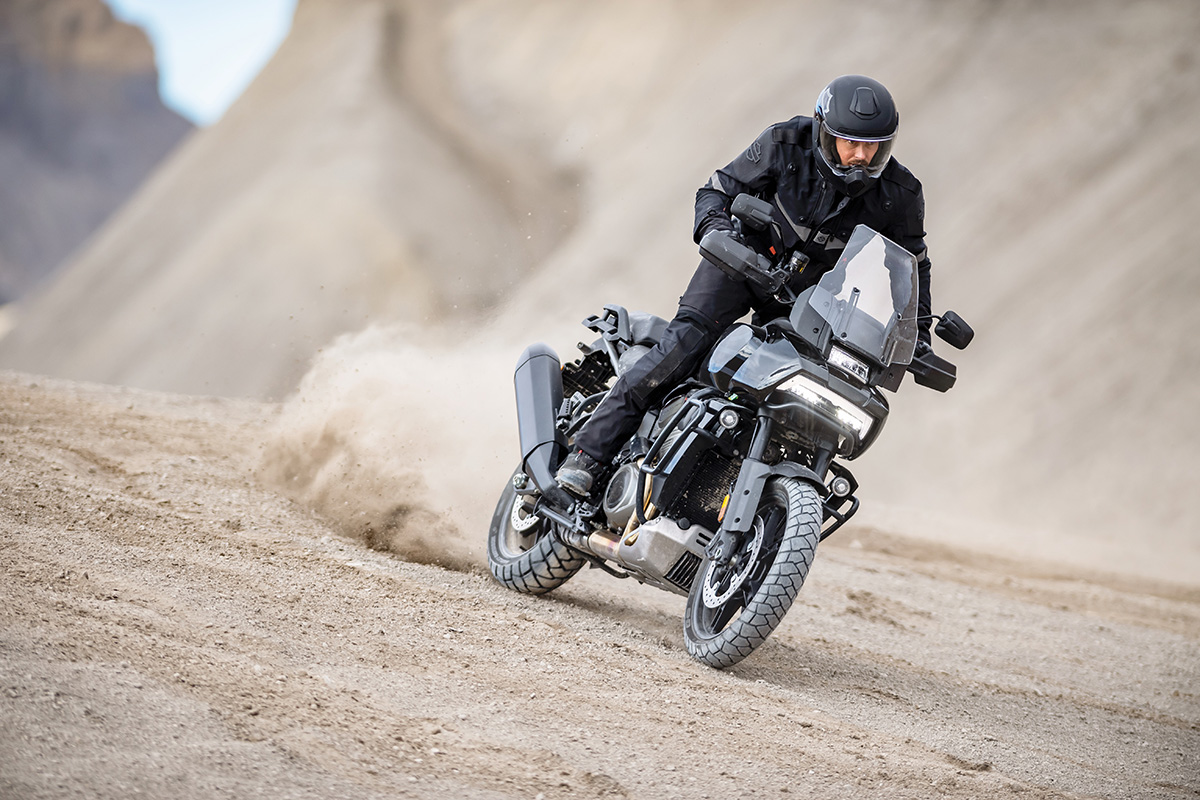
While the Special keeps a clear adventurous vocation, with longer-travel suspension, greater height and the ability to ride off the tarmac, the ST starts from a different premise: what happens if we optimise a big adventure bike for the roads we actually use most of the time?
The answer can be found in practically every element of the motorcycle.
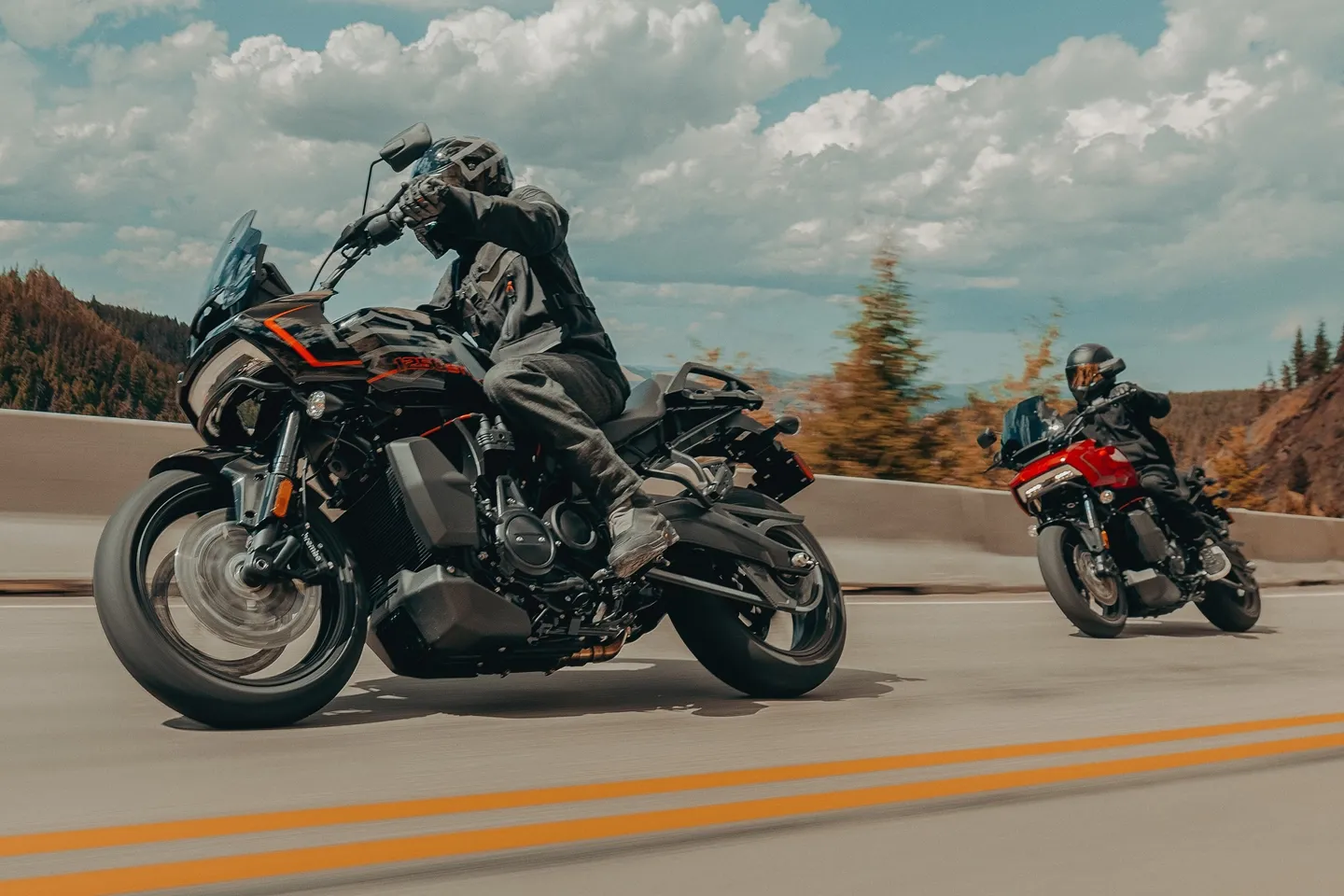
The Pan America 1250 ST uses 17-inch wheels front and rear, Michelin Scorcher Sport tyres, lowered suspension and a chassis configuration geared towards on-road behaviour. Seat height is 825 mm, while kerb weight is 246 kg.
These are not cosmetic changes.
A 17-inch front wheel, compared with the more common adventure-bike configurations, changes the steering response and allows the use of tyres specifically aimed at road riding. The lowered suspension reduces the centre of gravity and the overall height, while the road tyre makes it possible to make better use of the engine's performance in corners and under braking.
The result is a motorcycle that keeps the ergonomics and touring ability of an adventure bike, but clearly approaches the behaviour of a sport-tourer.
150 hp to enjoy Spain's roads
And here comes one of the Pan America ST's great arguments.
Its Revolution Max 1250 engine delivers 150 hp and 127 Nm of torque, figures that place the Harley in very serious performance territory.
It is not just about having a high power figure.
What is interesting is how that engine is combined with a chassis designed for tarmac. The ST lets you make the most of the Revolution Max's performance in a setting where a 150 hp motorcycle truly makes sense: mountain roads, flowing bends, overtaking and long road journeys.
In addition, the ST features a quickshifter, and for the 2026 model Harley-Davidson has evolved this technology with a clutchless Screamin' Eagle Quick Shifter, together with new riding modes.
And here, Spain plays in its favour
If there is a market where a motorcycle like the Pan America ST has especially interesting arguments, that market is Spain.
Not because Spain is necessarily a country of great distances, but for something much more important: the huge variety of roads we have to enjoy a motorcycle.
We have motorways and dual carriageways to travel quickly, but also a huge number of secondary roads, mountain passes and routes full of bends.
From the Pyrenees to the Sierra Nevada, via the Picos de Europa, the Central System, the Iberian System, the Levantine ranges or the roads of Andalusia, Spain offers an enormous number of settings in which a motorcycle of this kind can show what it is capable of.
And there, the ST's configuration makes particular sense.
We don't need a 21-inch front wheel to ride a paved mountain road.
We don't need huge suspension travel.
We don't need a seat height close to 900 mm.
And we probably don't need a motorcycle designed to overcome off-road obstacles that we will never encounter.
What we do want is a motorcycle that is comfortable for travelling, powerful when a twisty road arrives, manageable when we enter a city and capable of covering many kilometres without turning every journey into an endurance test.
The ST fits that description exactly.
17 inches: a decision that changes the motorcycle
One of the elements that best explains the ST concept is precisely its wheels.
The 120/70 ZR17 front and 180/55 ZR17 rear combination is unmistakably road-oriented. Harley-Davidson fits Michelin Scorcher Sport tyres as standard and has developed the chassis around this configuration.
This has an important consequence: the Pan America stops behaving like an adventure bike that can go fast on the road and becomes a motorcycle that wants to go fast on the road.
The steering, the feeling of grip, the ability to change line and the behaviour of the tyres are much more aligned with what we expect from a sporty road motorcycle. And all of this while keeping a high, comfortable riding position.
An adventure bike for those who don't really need one
Here, probably, lies the Pan America ST's greatest conceptual virtue.
It may seem a contradiction, but it isn't.
The ST keeps a good part of the advantages of an adventure bike:
- Upright riding position.
- Good visibility.
- Ability to cover long days in the saddle.
- 21.2-litre fuel tank.
- Ergonomics designed for travelling.
- Aerodynamic protection.
- The possibility of fitting equipment and travel accessories.
But it gives up some of the compromises needed to make an adventure bike truly versatile off the tarmac.
It is a sort of raised sport-tourer.
And that concept makes a lot of sense for the rider who wants to head out on a Saturday morning, cover 300 or 400 kilometres, cross several mountain passes, stop for lunch in a small village and come home by a different road.
Without having to look for a dirt track.
Seat height matters too
There is another especially interesting aspect for the Spanish market: accessibility.
The ST has a seat height of 825 mm, considerably lower than the more adventure-oriented Pan America Special.
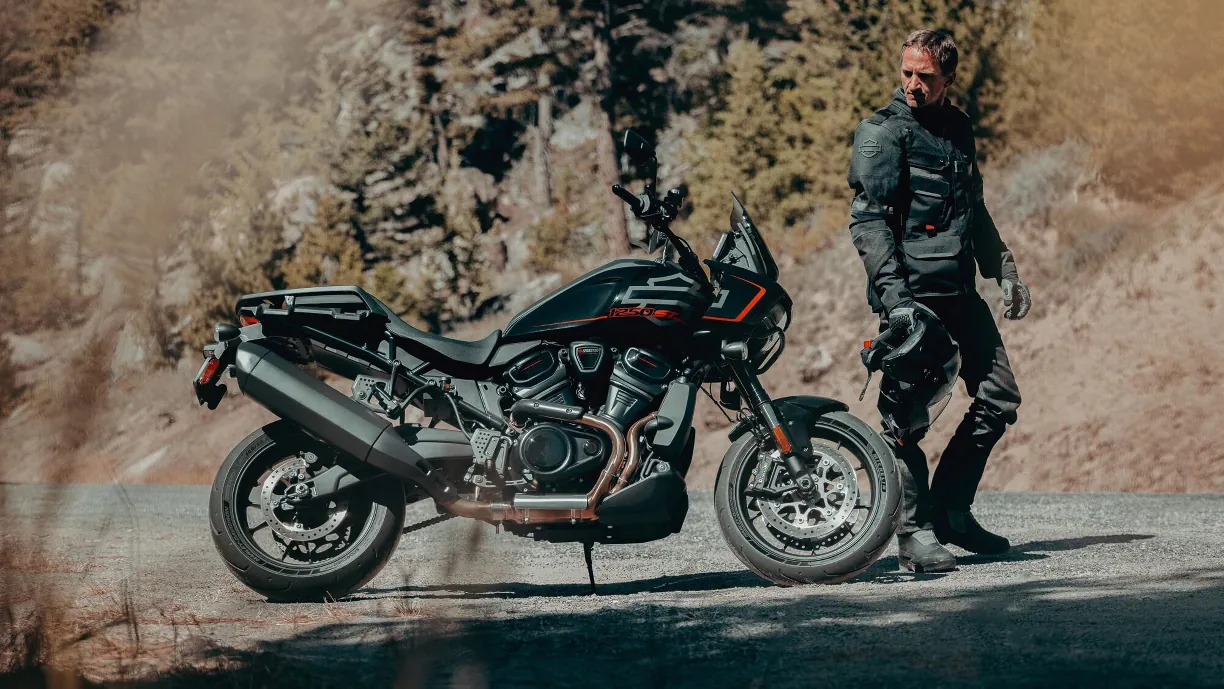
This does not make the ST a small motorcycle —it is still a 246 kg machine in running order—, but it does considerably change the rider's relationship with the bike.
In the city, in low-speed manoeuvres, when stopping at traffic lights or when constantly getting on and off the motorcycle, those centimetres can make an important difference.
They also widen the range of riders for whom a Pan America can be appealing.
A very competitive Spanish market
The interesting thing is that the Pan America ST is not arriving in an empty market.
Quite the opposite.
Spain has a strong offering of sport-touring, crossover and road-oriented adventure motorcycles. Models such as the Yamaha Tracer 9 GT, the Ducati Multistrada V2 or the BMW S 1000 XR compete, from different philosophies, for the same type of rider: the motorcyclist who wants performance, travel and fun on the road.
For example, the Yamaha Tracer 9 GT currently starts at 16,399 euros and offers 119 hp, while the 2026 BMW S 1000 XR is listed at an RRP of 22,570 euros in Spain. Ducati prices the new Multistrada V2 from 16,790 euros.
The 2026 Pan America 1250 ST starts at 21,900 euros in Spain.
Therefore, its argument cannot simply be price.
Its argument is something else.
It offers an uncommon combination: 150 hp, 127 Nm, 17-inch wheels, a chassis clearly focused on tarmac, an adventure-bike riding position, touring ability and, above all, the character and personality of a Harley-Davidson.
And that last part is no minor detail.
Character as the differentiating factor
In a segment where many motorcycles are conceptually similar, Harley-Davidson brings something that is hard to measure on a spec sheet.
The Pan America ST does not try to hide that it is a Harley.
The Revolution Max V-Twin engine, the design of the tank, the front end, the sound, the brand image and all the personality associated with the Bar & Shield give the ST an identity of its own.
It is a motorcycle that can tackle a mountain road with a completely different philosophy from that of a traditional cruiser.
And that is precisely what is interesting.
The Pan America ST shows that Harley-Davidson does not need to limit itself to a single type of motorcycle.
The Pan America that many may have been waiting for
The arrival of the ST can also be read as a response to an evolution of the market itself.
For years we have witnessed a genuine technological race in the adventure segment: more suspension travel, more electronics, off-road modes, spoked wheels, semi-active suspension and ever greater ability to ride off the tarmac.
But there is another trend.
The rider who wants a great motorcycle for travelling and enjoying the bends, but who knows perfectly well that 99 % of their kilometres will be on tarmac.
For that rider, adding off-road capability they will probably never use can mean accepting unnecessary compromises.
The Pan America 1250 ST removes some of those compromises.
And it does so without giving up the essence of a Pan America.
A Harley for the roads we really enjoy
The big question is not whether the Pan America ST can leave the tarmac.
The right question is a different one:
How many riders really need their motorcycle to be designed to do so?
For those looking for a genuine adventure bike capable of tackling tracks and difficult terrain, the Pan America Special still makes much more sense. Harley-Davidson maintains precisely that differentiation within the range: the Special is aimed at terrain beyond the tarmac, while the ST is configured specifically around the road.
But for those who understand adventure as a secondary road, a mountain pass, an endless succession of bends and hundreds of kilometres ahead, the Pan America ST can be especially appealing.
Because perhaps the real adventure is not about leaving the road.
Perhaps it lies in finding the right road.
And in Spain, we have quite a few of those.