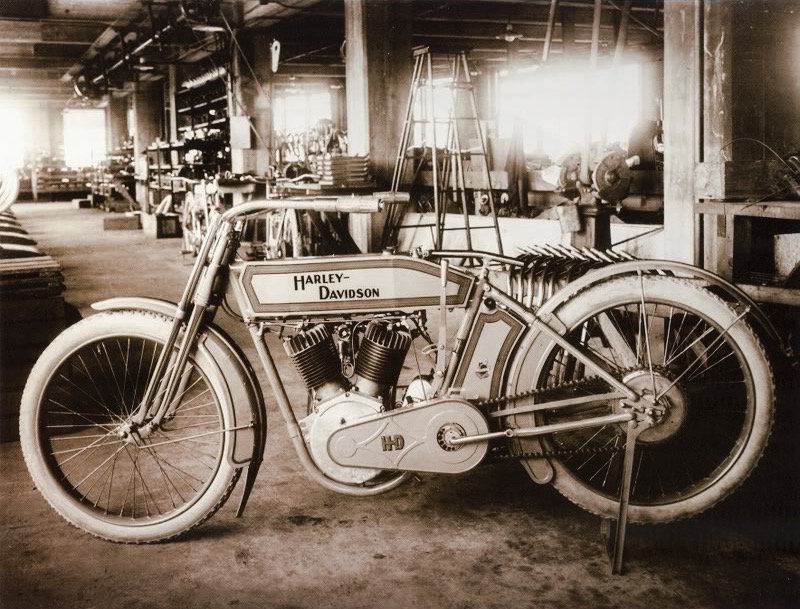
The history of the Harley-Davidson Sportster is also the history of a fundamental part of Harley-Davidson. From its birth in 1957 to today's Sportster S and Nightster, very few motorcycles have managed to remain for so many decades in the collective imagination of enthusiasts.
The Sportster was born to answer a challenge. British motorcycles, lighter, nimbler and sportier, were gaining ground in the United States and Harley-Davidson needed an answer. That answer was a motorcycle that would end up becoming much more than a model.
The Harley-Davidson Sportster was sporty, custom, urban, a racer and, for thousands of riders, their first Harley-Davidson; it was also one of the great customisation platforms in motorcycling history and, above all, it was a motorcycle able to evolve without losing its identity.
When was the Harley-Davidson Sportster born?
The Harley-Davidson Sportster was born in 1957, although its roots go back a few years earlier.
In the early 1950s, Harley-Davidson was facing a new scenario. Indian, its great American rival, had stopped making motorcycles in 1953, but the American market was starting to receive a new threat: European bikes. Triumph, Norton, BSA and other British manufacturers offered lighter, more manageable and sportier motorcycles. Harley-Davidson needed to compete on different ground from its big traditional V-Twins; the first answer was the Model K, introduced in 1952. The K brought in a different philosophy: a more compact and sporty motorcycle, with the gearbox integrated into the engine, rear swingarm suspension and an approach clearly geared towards performance; that motorcycle was the origin of the future Sportster.
In 1957 the XL Sportster arrived, and with it began one of the most important stories in Harley-Davidson's history.
1957: the Sportster legend is born
The first Harley-Davidson Sportster was based on the K platform, but it incorporated a fundamental technical change: a new overhead-valve V-Twin engine; the initial displacement was 883 cc. The cast-iron cylinder heads of the new engine would give rise to one of the best-known names in Harley-Davidson history: Ironhead.
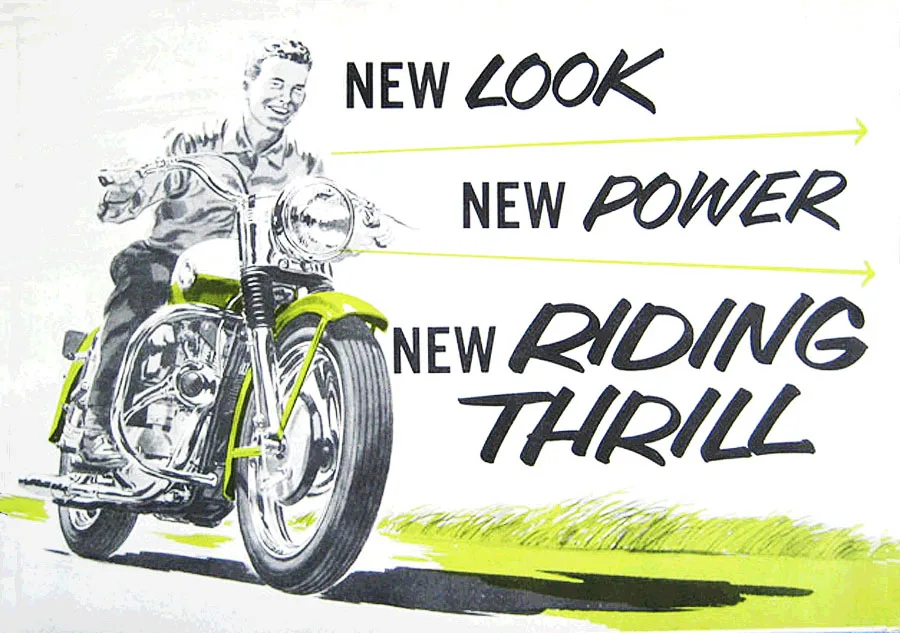
The Sportster was more compact and sporty than the big Harley-Davidsons of the time and quickly showed that it had not been born simply to fill out the catalogue. In the very year of its launch, a Sportster won the demanding Jack Pine Enduro; in addition, custom builders started modifying it practically from the beginning. The Sportster had quickly found two of the characteristics that would define its future: performance and personalisation.
A Harley-Davidson designed to race
Talking about the history of the Sportster also means talking about racing.
In 1958 the XLCH appeared, a version with a marked sporty character, aimed at TT racing, scrambles and other off-road disciplines, but the Sportster's influence on competition would reach one of its high points in 1970 with the arrival of the XR-750. The XR-750 was born using the Sportster engine architecture as its starting point and would become one of the most successful racing motorcycles in the history of American flat track. The connection between the Sportster and the XR-750 shows something important: the sporty character of the Sportster was not a marketing strategy created decades later, it was part of its DNA from the start.
Ironhead: the heart of a generation
For almost three decades, the Sportster was associated with the Ironhead engine, from 1957 until the mid-1980s; that V-Twin became one of the brand's great symbols. The Ironhead did not try to resemble the Japanese or European engines of the time, it was pure Harley-Davidson, mechanical, forceful, full of character and with a personality you could feel from the first twist of the throttle; the Sportster and the Ironhead ended up forming an inseparable pair. And that mechanical personality contributed enormously to building the legend.
The XLCR: when Harley-Davidson built a café racer
In 1976 Harley-Davidson showed once again that the Sportster could be much more than a cruiser: the XLCR Café Racer arrived. The motorcycle, developed under the direction of Willie G. Davidson, took the Sportster concept to a completely different place: compact tank, sporty riding position, aggressive styling and a clear inspiration from European café racers. The XLCR was not a massive commercial success, but it did leave an enormous mark; today it is considered one of the most special and recognisable Sportsters in history, and a characteristic that repeats again and again shows up once more: the Sportster's ability to become something different without ceasing to be a Harley-Davidson.
1986: the Evolution engine arrives
The story of the Sportster could have ended with the Ironhead, but it did not: in 1986 Harley-Davidson introduced the Sportster Evolution, initially with 1,100 cc. The change meant a genuine technological renewal; the new engine used aluminium cylinders and heads and brought important improvements in reliability, behaviour and efficiency. The Sportster was starting a new stage, the displacement would later grow to 1,200 cc and the Evolution engine would become one of the great protagonists of Harley-Davidson's recent history. According to historical documentation from the brand itself, hundreds of thousands of Evolution-equipped Sportsters have been built since 1986. The Sportster had not only survived, it had come back stronger.
The Harley-Davidson Sportster as the gateway to the brand
Here we find one of the Sportster's most important contributions to Harley-Davidson. For decades, the Sportster was the gateway to the Harley-Davidson world for thousands of riders. Its more compact size, its relative ease of riding and its wide variety of configurations allowed people to approach the brand from a different perspective. A Sportster 883 could be the beginning, then a 1,200 could follow and later a Softail, a Touring or any other model in the range; the importance of this phenomenon goes far beyond the sales of one particular motorcycle. The Sportster helped create new customers for Harley-Davidson, but it also created something even more valuable: riders who developed an emotional bond with the brand.
The Sportster: a motorcycle to make your own
If there is one word inseparable from the Sportster, that word is customisation. Since the 1950s, owners began to transform their Sportsters and, over the decades, the platform became one of the favourites for creating: bobbers, choppers, café racers, scramblers, street trackers, minimalist builds, completely personalised projects. Harley-Davidson itself recognises this ability to transform as one of the Sportster's fundamental characteristics and probably here we find one of the most important reasons for its success: a Sportster did not have to stay as it had left the dealership, it could become its owner's motorcycle; the Sportster was, in a way, a canvas and every owner could paint their own.
Sportster 883, Sportster 1200 and the explosion of versions
During the 1990s and 2000s, the Sportster family multiplied its possibilities. Different versions and concepts appeared: 883, 1200, Custom, Roadster, Nightster, Iron, Forty-Eight, SuperLow, XR1200 and 72, among others; the formula was clever. Harley-Davidson could use the same mechanical base to offer motorcycles with completely different personalities. A Sportster could be simple and minimalist, it could be sporty, aggressive, have a classic look, become a bobber or serve as the starting point for a personalised build. The Sportster platform showed an extraordinary ability to adapt.
Dark Custom: a new generation discovers the Sportster
The arrival of the Dark Custom trend was another important moment. Harley-Davidson began to connect with a generation of riders looking for a darker, more minimalist and urban look, and the Sportster was perfect for that language. The Iron 883 became one of the great examples of this new interpretation: everything in black, minimalism. The Sportster showed once again that it did not need to change its essence to connect with a new generation, it only needed to reinterpret itself.
2021: Harley-Davidson reinvents the Sportster
In 2021 came one of the most important changes in the whole history of the model: Harley-Davidson introduced the Sportster S and, this time, the transformation was much deeper. The new Sportster left behind the traditional Evolution architecture and introduced the modern liquid-cooled Revolution Max 1250T engine. The Sportster concept was definitively entering a new era.
The Sportster has never meant exclusively a particular engine, displacement or frame: the Sportster was, and still is, an idea.
The Sportster in 2026: a legend that is still alive
The story does not end here: in 2026, Harley-Davidson continues to use the Sportster name within its Sport range. The current family includes the Sportster S, Nightster and Nightster Special, showing that the motorcycle introduced in 1957 still has an enormous influence on the contemporary range.
The 2026 Sportster S features the Revolution Max 1250T engine with 121 hp and 125 Nm, performance-oriented suspension and styling that combines elements inspired by Sportster tradition with contemporary technology; on the other hand, the 2026 Nightster takes the Sportster philosophy to a lighter, lower and more accessible motorcycle, with a Revolution Max 975T engine, 89 hp and a seat height of 705 mm.
In other words: the Sportster has changed, but it has not disappeared.
What did the Sportster really give Harley-Davidson?
This is the fundamental question because the importance of the Sportster cannot be measured only in units sold. Its real impact can be understood from five perspectives.
1. It widened Harley-Davidson's audience
The Sportster allowed Harley-Davidson to enter the territory of more compact, sporty and accessible motorcycles. For decades it was the gateway for thousands of new customers.
2. It proved a Harley could be sporty
From the XLCH to the XR-750, the Sportster helped build a sporty side of Harley-Davidson that is still present in the current range.
3. It created a culture of personalisation
The Sportster made transforming the motorcycle part of the very experience of owning one.
4. It was a laboratory for Harley-Davidson
For more than six decades, the Sportster platform allowed experimentation with engines, designs, ergonomics, styles and new audiences.
5. It built an emotional connection
For many owners, the Sportster was not simply a motorcycle, it was their first Harley-Davidson; for others it was the bike they modified for years and for others it became the Harley that best represented their way of understanding motorcycling.
That emotional bond is probably the Sportster's greatest legacy.
Harley-Davidson Sportster: more than a motorcycle, a culture
The Sportster remains a Harley-Davidson that invites you to make it your own, and that is its true legacy. That is the reason it is still a legend.