Why a Harley-Davidson Is the Perfect Canvas
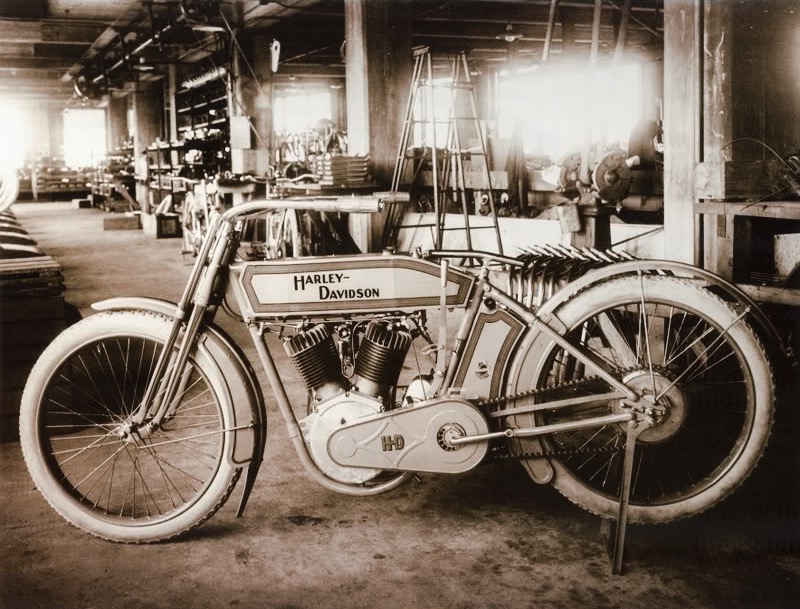
A stock Harley-Davidson is only the beginning of the story. The real adventure, the one that tells who you are, begins when you make it your own. Because a Harley isn't just a motorcycle; it's a statement, an extension of personality forged in steel, aluminum and chrome. This isn't a new concept: it's a tradition that goes back to the origins of biker culture, a DNA of individuality that has pulsed through every V-Twin engine since 1903.
From its earliest years, Harley-Davidson owners began modifying their machines. They removed parts, added others, painted their tanks in colors that didn't exist in the catalog. The Milwaukee factory quickly understood: customization wasn't a threat to the brand, it was its greatest asset. Today, Harley-Davidson is the only major motorcycle brand that has built a complete ecosystem around customization, with a genuine accessories catalog of more than 3,000 components and a factory customization program called Screamin' Eagle. That's no coincidence; it's the result of more than a century of listening to its customers.
If you want to understand where this culture comes from, we recommend reading our story about how Harley-Davidson was born in a shed and turned into a legend. Understanding the brand's origin is understanding why customization is part of its essence.
This guide is the map for navigating the world of customization in Barcelona. From choosing the style that defines you to understanding the technical and legal process so your motorcycle becomes a 100% functional and legal work of art.
The Great Custom Styles: Find Your Identity
Within customization culture, styles are like languages. Each one has its own vocabulary of shapes, parts and attitudes. Knowing them is the first step to defining your vision and telling your workshop exactly what you're looking for.
The Bobber Style: Minimalism and Attitude
Core philosophy: "Less is more." The Bobber style was born in the 1940s, when post-war riders stripped their motorcycles of anything they considered superfluous to gain speed and agility. It's a raw, honest style, with an unmistakable character and an attitude that needs no adornment to make its mark.
Defining characteristics of the Bobber style:
| Element | Description |
|---|---|
| Fenders | Trimmed down to a minimum, or the front one removed entirely. |
| Seat | Solo, low and often "floating," suspended directly over the frame. |
| Handlebar | Low and straight (Drag Bar) or slightly curved, seeking an aggressive, direct riding position. |
| Tires | Wide and high-profile, often the same diameter on both wheels, giving a muscular, compact appearance. |
| Overall Look | Removal of chrome and superfluous trim. Matte black finishes and solid colors predominate, giving an appearance that conveys strength without frills. |
Ideal bases: The Sportster family, such as the Iron 883 or the Forty-Eight, is the quintessential starting point. Models such as the Street Bob or the Softail Standard are also perfect canvases. The versatility of the Sportster family, in both its classic and modern Nightster and Sportster S versions, makes it the undisputed queen of the Bobber style.
Rider profile: An urban rider, a lover of vintage aesthetics, who values agile handling and a direct, unfiltered connection with the machine.
The Chopper Style: Radical and Exaggerated
Core philosophy: "Break all the rules." If the Bobber is minimalism, the Chopper is excess and boundless creative freedom. Born from the Californian counterculture of the 1960s and 70s, it's the ultimate expression of individuality, immortalized in films such as Easy Rider (1969) and turned into the symbol of an entire generation.
The Chopper takes customization to the extreme. Here it's not about removing parts, but redesigning the motorcycle from scratch. The forks are stretched to the point where the front wheel seems to want to escape toward the horizon. The handlebar climbs skyward. The frame is modified, cut, welded. The result is a kinetic sculpture that defies every convention.
| Element | Description |
|---|---|
| Forks | Extremely long with a large rake angle, creating the style's unmistakable silhouette. |
| Handlebar | Very tall, above shoulder height. Known as "Ape Hangers" or "Sissy Bars." |
| Frame | Often radically modified, sometimes rigid (no rear suspension) for a cleaner, lower line. |
| Wheels | Very thin, large-diameter front wheel, contrasting with a very wide rear wheel. |
| Tank | Small and raised, usually "Peanut" or "Frisco" style. |
| Overall Look | Elaborate paint jobs and airbrushing, lots of chrome, obsessive attention to detail and a presence that leaves no one indifferent. |
Ideal bases: The Softail and Dyna families are preferred for their frame geometry. Often, the most ambitious Chopper projects start from a used Harley-Davidson, taking on such a radical transformation without the emotional weight of modifying a new bike.
Rider profile: A born individualist, a lover of the open road, and unquestionably the center of every gaze.
The Bagger Style: Comfort and Miles with Style
Core philosophy: "Devour the asphalt without giving up style." The Bagger is the perfect symbiosis between custom aesthetics and the functionality of a touring motorcycle. It's the answer for those who want to cover thousands of miles on a motorcycle that commands as much as it comforts.
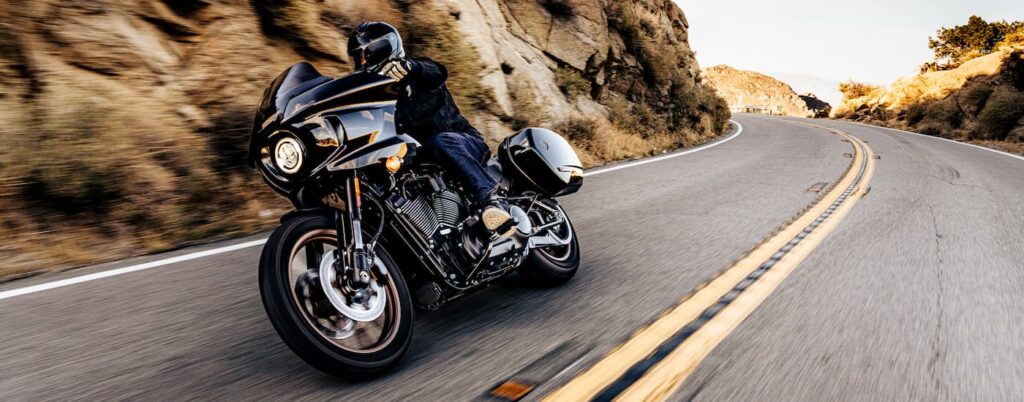
The term "Bagger" comes from the hard "bags" that characterize these motorcycles. But a Bagger isn't simply a touring bike with saddlebags; it's a statement of power and style. The bags are stretched to the end of the exhaust, the front wheel grows to 21 or 23 inches, the air suspension lowers the bike until it almost touches the asphalt at a standstill. The result is a low, long and absolutely commanding silhouette.
| Element | Description |
|---|---|
| Saddlebags | Hard bags integrated into the motorcycle's line, often "stretched" to the end of the exhaust. |
| Fairing | Prominent front fairing, such as the iconic "Batwing" or the "Shark Nose." |
| Front Wheel | Large diameter, with 21-, 23- or even 26-inch wheels being common. |
| Suspension | Often air suspension, allowing the bike's height to be lowered at a standstill for a spectacular visual effect. |
| Overall Look | Powerful sound systems, custom paint across the whole bodywork, and a low, long, dominant silhouette. |
Ideal bases: The Touring family is the natural starting point (Street Glide, Road Glide, Electra Glide). However, it's also popular to "baggerize" Softail family models such as the Heritage Classic or the Fat Boy.
Rider profile: A tireless traveler who values comfort and carrying capacity, but refuses to go unnoticed.
The Cafe Racer Style: Agility and Racing Spirit
Core philosophy: "From cafe to cafe, at full speed." Although its origins are British (the roadside cafes of 1950s England were the meeting point for the first "ton-up boys"), custom culture has embraced the Cafe Racer for its focus on performance, lightness and a committed, sporty riding position.
The Cafe Racer applied to a Harley-Davidson is an apparent contradiction that, when done well, produces spectacular results. Taking the weight and torque of a V-Twin engine and fitting it into a sporty riding geometry creates a machine with a unique personality: American muscle with the agility of a European sportbike.
| Element | Description |
|---|---|
| Handlebar | Low, such as clip-ons mounted to the forks or "Clubman" style. |
| Footpegs | Set further back to achieve a more sporty, aerodynamic riding position. |
| Seat and Tail | Solo tail section and a long, narrow fuel tank, often with leather knee pads. |
| Exhausts | Raised and short, often with a throaty, sporty note that contrasts with the deep burble of the V-Twin. |
| Frame and Suspension | The goal is to lighten the frame and upgrade the suspension for more agile handling in corners. |
Ideal bases: The Sportster family, especially models such as the Roadster or the XR1200, are perfect for their agility and relatively light chassis. Dynas are also an excellent base thanks to their frame rigidity and the sportier riding position they offer.
Rider profile: A lover of winding roads and spirited riding, with a deep appreciation for the retro aesthetic of 1950s and 60s racing.
The Scrambler Style: Adventure as Philosophy
Core philosophy: "The road is just the beginning." The Scrambler is the most versatile and adventurous style in the custom universe. It was born from the need for a motorcycle that could handle both asphalt and dirt, and its aesthetic reflects that duality: rugged yet agile, classic yet ready for the unexpected.
In the Harley-Davidson context, the Scrambler is relatively new territory but one in full expansion, especially since the arrival of the Pan America. However, the tradition of prepping Sportsters for off-road use is as old as the motorcycle itself.
| Element | Description |
|---|---|
| Tires | Mixed on/off-road profile, with pronounced knobs for grip on dirt. |
| Exhausts | Raised on both sides ("high pipes"), to protect them from impacts with the terrain. |
| Fenders | Tall and with plenty of clearance from the tire to prevent mud build-up. |
| Handlebar | Wide and tall, "Enduro" or "Scrambler" style, for greater control on uneven terrain. |
| Overall Look | Rugged, functional look, with engine guards, canvas saddlebags and a "ready-for-adventure" appearance. |
Ideal bases: The Sportster and the Pan America 1250, with its 1,252cc Revolution Max engine, are the most natural platforms for this style.
How Much Does It Cost to Customize a Harley-Davidson?
This is, without a doubt, the most frequent question. The most honest answer is that the cost of customizing a Harley-Davidson is as unique as the project itself. There's no standard price or fixed price list, because every motorcycle and every vision is different.
The budget can range from a few hundred euros for basic aesthetic changes (a new handlebar, a custom seat, different grips) to figures that exceed the value of the motorcycle itself for complete, radical transformations involving structural modifications, hand-crafted paintwork and complex homologation.
| Factor | Description | Investment Level |
|---|---|---|
| Parts and Accessories | The choice between genuine Harley-Davidson parts, components from prestigious aftermarket brands (Performance Machine, Roland Sands Design, Arlen Ness), or hand-crafted made-to-order parts. | Variable (Low to Very High) |
| Specialized Labor | The shop hours needed to install, adapt, modify and fit each component. Quality work takes time and experience. | Medium to High |
| Paint and Finishes | From a high-quality single-stage paint job to multi-layer artistic airbrushing with special effects. Paint is often the element that most defines a custom motorcycle's character. | Medium to Very High |
| Homologation | The costs of the legal process to register the modifications on the vehicle's registration document. Varies according to the complexity of the modifications. | Low to High |
The best way to find out the real cost of your project is to talk to our team. At our customization workshop in Barcelona, our specialists can advise you and offer you a detailed, no-obligation quote. Request your appointment here.
The Most Popular Modifications: From Simple to Radical
To help you size up your project, here's a breakdown of the most common modifications, ordered from lowest to highest complexity:
Level 1 Modifications — Basic Aesthetic and Functional: Changing the handlebar, installing a new custom seat, replacing grips and levers, changing mirrors, installing "bullet" or LED turn signals, changing decorative engine covers, painting the tank and fenders. These are modifications that visually transform the motorcycle without altering its fundamental mechanics.
Level 2 Modifications — Intermediate Mechanical and Aesthetic: Installing a new exhaust (homologated muffler or full system), changing tires to different sizes, modifying the rear suspension, installing a new high-performance air filter, changing the license plate mount, installing a complete LED lighting system. These modifications may require homologation.
Level 3 Modifications — Deep Transformations: Cutting and modifying the subframe to change the tail section, changing the forks or modifying the steering geometry, installing a rigid frame, engine tuning (Stage 1, 2 or 3), fitting large-diameter wheels, complete style transformations (Bobber, Chopper, Bagger). These modifications always require a technical homologation project.
The Customization Process at Our Barcelona Workshop
Transforming a motorcycle is an exciting journey. At Espacio Harley-Davidson Barcelona, we've refined a five-step process so you can enjoy every stage with total peace of mind and confidence.
Step 1 — The Vision: It all starts with a conversation. You come to our dealership and tell us your dream, your ideas, the style that inspires you. Our team of specialists listens to you and advises you on feasibility, options and real possibilities. There are no crazy ideas, only projects waiting to be defined.
Step 2 — The Design: We turn your ideas into something tangible. We create sketches or digital renders so you can visualize the final result before a single part is touched. In this phase, we fine-tune every detail with you: the exact color, the shape of the seat, the height of the handlebar, the type of exhaust.
Step 3 — Selecting the Components: We guide you through the vast universe of available parts. Whether you prefer the guaranteed quality of the genuine Harley-Davidson accessories catalog or you're after that exclusive niche aftermarket component, we help you choose the best option for your project and your budget.
Step 4 — The Magic of the Workshop: This is where the design comes to life. Our technicians, craftsmen passionate about the brand, work with meticulous precision. It's a process in which every bolt, every cable and every weld is carried out with the mastery your motorcycle deserves. We keep you informed of every step forward.
Step 5 — Homologation and Delivery: In parallel with the build, our technical department manages the entire homologation process. We make sure every modification complies with current Spanish regulations so your motorcycle leaves the workshop ready to ride and pass the ITV (Spain's roadworthiness inspection) without surprises.
Homologation in Spain: Your Custom Motorcycle, 100% Legal
Homologation is not a mere bureaucratic formality; it's the guarantee that your customized motorcycle is safe for you and for others. It's the legal process that certifies the modifications made comply with current regulations and registers them on the vehicle's registration document, in accordance with Royal Decree 750/2010, which regulates homologation procedures in Spain.
Which modifications require homologation in Spain?
| Requires Homologation? | Type of Modification | Examples |
|---|---|---|
| YES | Significant modification (requires a Conformity Report or Technical Project) | Changing the handlebar for one with different dimensions, suspension modifications, relocating the license plate mount, any cutting or welding on the frame or subframe, changing exhaust manifolds, fitting non-equivalent tires, brake modifications. |
| NO | Replacement with a part homologated for the model | Certified exhaust muffler stamped with "CE," turn signals and mirrors marked with "E," grips, footpegs, decorative covers that don't alter the dimensions. |
Important warning: Riding with non-homologated modifications can lead to financial penalties, impoundment of the vehicle and, most seriously, your insurance company refusing to cover damages in the event of an accident, since the vehicle no longer complies with the specifications on its registration document. The peace of mind of riding legally is priceless. Always trust a specialized workshop like ours to guarantee a flawless homologation process.
Which Harley-Davidson Models Are Best for Customizing?
Although any Harley-Davidson can be customized, some models offer a particularly versatile platform and greater availability of parts on the aftermarket:
| Model | Recommended Style | Reason |
|---|---|---|
| Sportster Iron 883 / Forty-Eight | Bobber, Cafe Racer | Simple chassis, exposed engine, huge parts catalog, accessible entry price. |
| Sportster Nightster / S | Modern Bobber, Cafe Racer | Revolution Max engine, modern chassis, aesthetic already custom-oriented. |
| Softail Standard / Street Bob | Bobber, light Chopper | Clean Softail chassis, Milwaukee-Eight engine, good base for mid-level projects. |
| Softail Breakout | Bagger, Chopper | 240 mm rear wheel as standard, already a very custom line straight from the factory. |
| Dyna (discontinued) | Cafe Racer, Chopper | Rigid, sporty chassis, very popular on the used market for custom projects. |
| Touring (Street/Road Glide) | Bagger | The perfect base for high-level Bagger projects. |
The Final Touch: The Rider's Style
Customization doesn't end with the motorcycle. The gear you choose for the ride is a fundamental part of your style statement. A leather jacket that ages with you and tells the story of the miles covered, a helmet that complements your tank's paintwork, gloves that speak of thousands of hours on the handlebar: these are the finishing touch to your look.
A customized motorcycle is a moving work of art, and the rider is its guardian and best complement. Discover how to complete your style with the authenticity and quality of official Harley-Davidson clothing and gear.
Frequently Asked Questions (FAQ) About Harley-Davidson Customization
Your Dream, Our Commitment
Customizing a Harley-Davidson is a journey, not a destination. At Espacio Harley-Davidson Barcelona, our team of specialists has spent years transforming Harleys into unique works of art. Ready to start creating the Harley of your dreams?
Contact our team of specialists